Infrastructure Standardization
A repeatable workstation configuration process designed to reduce rebuild time, improve consistency, and prevent recurring configuration issues.
Project Overview
Identified systemic inconsistencies in workstation builds that were driving configuration errors, longer rebuild times, and increased support overhead. Led the design and rollout of a standardized PC configuration and imaging framework, establishing a repeatable and scalable deployment model across the environment.
This initiative reduced rebuild time by 50% and decreased misconfigured systems by 95%, significantly improving desktop reliability, support efficiency, and overall user experience.
The Challenge
Operational Friction
PC builds varied depending on who performed the setup, increasing support issues and creating inconsistent user experiences.
Support Load
Misconfigured systems created avoidable follow-up work for IT and slowed down new user readiness.
Approach
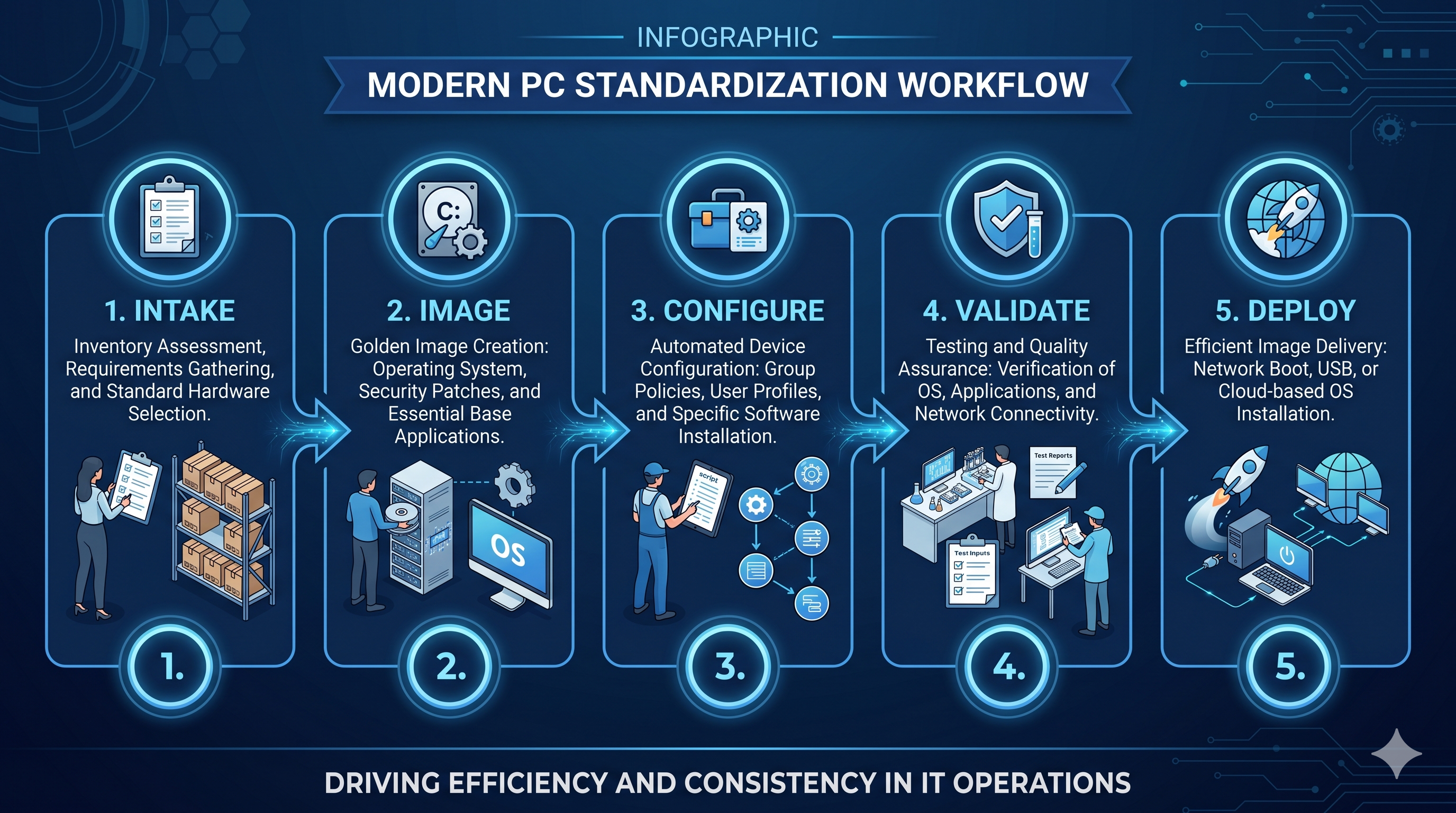
1. Identify recurring build issues
Reviewed common configuration problems and technician setup patterns.
2. Define the standard build
Clarified required settings, software, icons, network mappings, and validation steps.
3. Document the workflow
Created a technician-ready SOP that made the process repeatable and easier to train.
4. Validate before deployment
Built in quality checks to confirm domain, network, software, and user-readiness items.
Results
Why It Matters
This project demonstrates more than technical setup. It shows process ownership, operational discipline, documentation skill, and the ability to convert repeated IT pain points into a scalable support model.